Introduction
Industrial surface treatment often requires a balance between effective cleaning and protection of the underlying material.
When a conventional mineral abrasive is too aggressive for a particular substrate, walnut shell abrasives can provide an alternative worth considering.
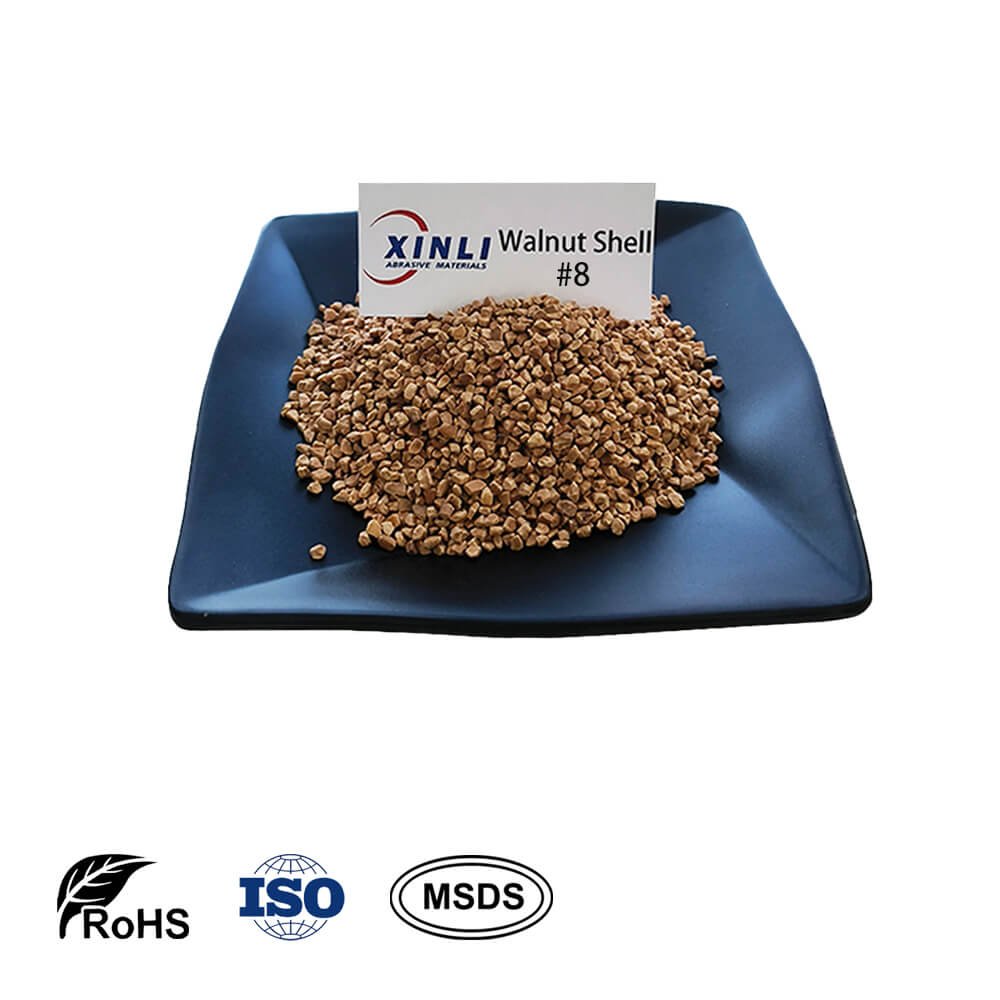
Walnut shell media are produced from processed walnut shells and are available in different particle sizes for applications including cleaning, polishing, blasting, and surface preparation.
Their natural hardness and irregular particle structure allow them to provide useful abrasive action while being less aggressive than many conventional mineral abrasives.
What Are Walnut Shell Abrasives?
Walnut shell abrasives are made by processing and grading walnut shell material into controlled particle sizes.
The shells are cleaned, processed, crushed, and screened to produce different grades.
Different particle sizes can provide different levels of cleaning and abrasive action, allowing walnut shell media to be adapted to different industrial processes.
Because walnut shell is a naturally derived material, it can be an attractive option for applications where manufacturers are looking for plant-based abrasive media.
1. Surface Cleaning
Walnut shell abrasives are commonly considered for surface cleaning applications.
They can help remove contaminants and unwanted material while providing a relatively controlled abrasive effect.
This makes them suitable for applications where aggressive cutting is not necessary or where protecting the underlying surface is important.
Potential applications include cleaning:
- Industrial components
- Machinery parts
- Metal surfaces
- Molds and tooling
- Selected painted or coated surfaces
The appropriate grade should be selected according to the substrate and contamination being removed.
2. Gentle Blasting
Walnut shell media can be used for blasting applications where a less aggressive abrasive is required.
Compared with harder mineral abrasives, walnut shell particles can provide a gentler impact on the surface.
This can be useful when the objective is to remove contaminants while maintaining the underlying substrate.
In blasting applications, operators should consider factors such as:
- Particle size
- Air pressure
- Nozzle configuration
- Distance from the workpiece
- Surface material
- Desired finish
These parameters can significantly influence the final result.
3. Polishing Applications
Fine walnut shell abrasives can also be used for polishing and finishing.
The particles can provide a controlled mechanical action that helps improve surface cleanliness and appearance without the aggressive cutting effect associated with some harder abrasive materials.
This makes fine walnut shell grades suitable for selected finishing processes where surface protection is important.
4. Removing Contaminants from Components
Another useful application is cleaning components that contain accumulated dirt, residue, or other unwanted materials.
Walnut shell media can be considered when the component requires effective cleaning but excessive abrasion could affect dimensions, appearance, or surface integrity.
This is particularly relevant for manufacturers working with components that need regular cleaning during maintenance or refurbishment.
5. Why Particle Size Matters
Choosing the correct walnut shell particle size is critical.
Coarser grades generally provide stronger mechanical action and can be useful for more demanding cleaning applications.
Finer grades are better suited to applications requiring a gentler treatment or more refined finishing effect.
For example, a manufacturer may choose different grades depending on whether the objective is:
Cleaning → Surface preparation → Light polishing → Finishing
The correct selection should always be based on the actual substrate and process conditions rather than particle size alone.
Walnut Shell vs. Conventional Mineral Abrasives
Walnut shell abrasives are not designed to replace every conventional abrasive.
Mineral abrasives such as aluminum oxide or silicon carbide are often preferred when high hardness and aggressive cutting are required.
Walnut shell media become more interesting when the application prioritizes:
- Gentler surface treatment
- Reduced risk of scratching
- Controlled cleaning
- Lightweight media
- Plant-based abrasive materials
- Reusable or recoverable blasting processes in suitable applications
The choice should ultimately depend on the material, contamination, equipment, and required surface finish.
Applications of Walnut Shell Abrasives
Walnut shell abrasives can be considered for a variety of industrial applications, including:
Surface Cleaning
Removing dirt, deposits, and contaminants from selected components.
Blasting
Providing controlled abrasive action for selected surface-treatment processes.
Polishing
Helping improve surface cleanliness and finish.
Maintenance
Cleaning industrial components where aggressive abrasion is undesirable.
Surface Preparation
Preparing selected surfaces for subsequent processing.
Conclusion
Walnut shell abrasives provide a plant-based alternative for applications requiring controlled cleaning, gentle blasting, polishing, and surface preparation.
Their natural characteristics and availability in different particle sizes allow manufacturers to select a grade according to the specific requirements of their process.
For applications where protecting the underlying surface is as important as removing contamination, walnut shell media can be a practical option to evaluate.
Xinli supplies plant-based abrasive materials including walnut shell, corn cob, and olive pit abrasives in different grades for industrial applications. Contact us to discuss the right abrasive material and particle size for your process.